Saturday, February 23, 2013

Palatines in North Carolina


Our Palatines to America treasurer, Margie Weiler, suggested that I include information in this blog about the 1710 settlement of New Bern, North Carolina.  I  have previously written about  the 1766 North Carolina settlement of Germans in Salem.  However the New Bern settlement deserves its own mention.

Christoph von Graffenried, a native of Bern, Switzerland, born in 1661 and Franz Ludwig Michel, both part of the Ritter Company, wanted to establish a Swiss colony in the New World.  Queen Anne of England, facing a flood of Palatine immigrants made an offer of land and support for the settlement plans if they would agree to include Palatines among those they transported to the New World. 


In September of 1709, Parliament granted Graffenried and Michel more than 13,000 acres of land in the Carolinas, with a promise of assistance once they arrived.  As a result, 650 Palatines, led by John Lawson and Michael Gale, sailed from England in January 1710.  During the thirteen week voyage, they lost about one half of the Palatines as a result of the harsh conditions of the trip. When they arrived in North Carolina at the juncture of the Neuse and Trent rivers, they found that no provisions were waiting for them and no work had been done to provide shelter for them in the settlement at New Bern.
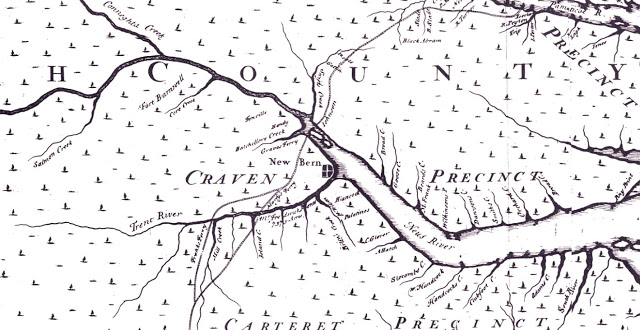

Conditions did not improve until Graffenried arrived in September 1710 with about 100 Swiss settlers.  He had the land surveyed, forests cleared and houses erected. Within eighteen months, the community seemed to be well established.  Unfortunately this good fortune did not continue for long.

The Tuscarora Indians who had inhabited the area until the arrival of European settlers, began a campaign to rid their native lands of those intruders.  In Early September 1711, Graffenried and surveyor John Lawson, who had led the initial group of Palatine settlers to New Bern, set off to explore the area north of New Bern.  The Tuscarora captured both, killing Lawson.  They let Graffenried go free because they believed that he was the governor.

While Graffenried was journeying back to New Bern, the Tuscarora attacked the white communities along the Neuse and Pamlico Rivers, killing many of the settlers.  They destroyed houses and crops and took away livestock. 

Graffenried never recovered financially from the war with the Tuscarora, and many of the original Palatines dispersed among the surviving English communities of North Carolina.  Graffenried returned to Europe.

Wednesday, January 30, 2013

Change in Speakers


The 2013 Palatines to America National conference had been planning to have as its two main speakers, Ernest Thode, and Mel Wolfgang.  On Monday, we received word from Mel’s wife, that Mel would not be able to attend the June conference, because he is undergoing treatment for a serious health condition.  I know this has not just affected the Palatine conference scheduled for June, but others such as the one sponsored by the New York Genealogical and Biographical Society and the Central New York Genealogical Society scheduled for September.

Fortunately, when contacted about the situation, Hank Z. Jones agreed to take Mel’s place at our conference, which is to be held at the Desmond Hotel in Albany, NY from the 20 to the 22 of June.  Hank is a well liked speaker and will undoubtedly attract some to attend who might otherwise have been absent.  Hank’s topics will include: “When the Sources Are Wrong”, “Tracing the Origins of Early 18th Century Palatine & Other Emigrants”, and “Family Traditions: How to Separate Fact From Fiction in Genealogical Research.”

We are also planning to offer a bus trip to Mohawk Valley historic sites on the Wednesday before the conference formally begins.  Barbara de Mare of the NY Chapter has been planning it and hopes to have the details worked out before our conference registration material is sent out.

Check on our website, www.palam.org, for information as it becomes available.

Saturday, January 26, 2013

Kocherthal Circle


Last July, I wrote about the lineage society that Palatines to America had established for those who are descendants of those early Palatines who came to this country under the leadership of Lutheran minister Joshua Kocherthal.  They arrived in New York during the period of 1708 to 1711 and settled initially along the Hudson River.  They then relocated to the Schoharie and then the Mohawk Valley.  This lineage society, a part of the Palatines to America is meant as a means for the descendants of those early Palatines to establish their claim to that lineage.

We are hoping that some members of the Palatines to America will have completed the application and be inducted into the Kocherthal Circle at our June 2013, National Conference in Albany, NY.  

I would encourage anyone who claims those early Palatines as their ancestors to download an application from our website at www.palam.org and complete the process.  If you have already documented your family history back to those Palatines, the process should be relatively easy.  However there is a March 15 deadline for submitting the application and documents needed to become a member.

You could become one of the charter members of the Kocherthal Circle.  Getting started now, and join us in Albany in June.

Friday, December 14, 2012

A Necessary Detour


I began this day with the intention of writing a very different blog. However, events today have made me decide that I should address a very different topic.  Today is Dec 14th, a day on which someone decided that murdering a classroom full of innocent kindergarten child in an elementary school in Newtown, CT would somehow make his life and death more noticeable.  There were adults killed as well, but the death of all those young children remains the focus.

At this time, no motive has been put forward.  And even if the police found an apparent motive, what would justify the murder of all those innocent children?  Of course in the New Testament, we hear of King Herod who gave orders to slay all the young boys of Bethlehem to try to make sure that the newborn King of the Jews was not alive to challenge him for his throne. 

But that was then, and this is too much in our present. I know this has nothing to do with our German heritage.  I will return to that in my next blog.  But for now, I would ask that you all join me in prayer for those children, their families and classmates who will need our prayers to recover from the horrors of this day. 

Friday, November 23, 2012

North Carolina Germans


We have all heard the stories of the Palatines who came to New York in the Eighteenth Century and the  Pennsylvania Dutch (German) who settled in the that state.  But, there are many other stories that have not been as well known.

The most recent chapter of Palatines to America is our North Carolina Chapter.  Some may wonder about why a North Carolina Chapter would make sense.  It is certainly not one of the better known stories of German immigration, except perhaps to those whose ancestors were among the groups that settled in that southern state or to those who live in that southern state.

I was reminded of the history of German settlers in North Carolina by my sister and her husband who made a trip to Winston-Salem, North Carolina and reported with enthusiasm the discoveries they made in Old Salem, the historic site where German Moravians who moved from Bethlehem, PA founded the city of Salem, NC in 1766.  It is now an historic district within Winston-Salem.


The history of Germans in North Carolina is much
richer than the story of those German Moravians,
and I would be happy to add more details if
 someone would like to write a more extensive
history of the Germans of North Carolina and
send it to me. Perhaps someone in the
North Carolina Chapter could submit something
 to be published in this blog.

The stories of our German ancestors are many and
varied, and I don’t pretend to be familiar with all
of them.  If you know some of those stories and
would like to make them known, send them along
 to me at palatinenotes@gmail.com. You can take
credit for the story;  I will make it available for
others to read.