Wednesday, March 27, 2013

Library and Archives tour


Bus Trip to NYS Library and Archives

Date:  20 June, 2013
Cost: $40
Departure: 9:30 am from the Desmond Hotel
Return:  About 4 pm from the Cultural Center on Madison Ave., Albany

The 2013 Palatines to America National Conference is being held in an exciting part of our country, where so much history has taken place.  Albany, New York is situated on the Hudson River, about one hundred and fifty miles north of New York City.  Henry Hudson, exploring for the Dutch and looking for a shorter route to Asia, sailed up this river in 1609 as far as the Cohoes Falls above Troy.  Soon after, trading began with the Indians and settlements were established, first on Manhattan Island and then at Fort Orange (Albany).  Early Palatines in the 1700s traveled through Albany as they sought better conditions further inland.  Later immigrants traveled by boat up the River and over Mohawk River and Erie Canal as they moved farther and farther west. 

General Burgoyne was held prisoner at General Philip Schuyler’s home in Albany after the British defeat at Saratoga in 1777.  Palatines fought in the French and Indian War and the Revolutionary War.  New York played a significant role in the War of 1812.  The Albany area was a major staging area for important battles in the north with Canada during that war.  A pivotal role was played by New York in the Civil War.  As the most populous and wealthiest state at the time, it supplied the most men, money and material in the north’s struggle with the south.  A major exhibit available for viewing at the New York State Museum, which shares the Cultural Building with the State Library and Archives is “An Irrepressible Conflict – The Empire State in the Civil War.”    An immense collection of information is available to the researcher in the collections archived here in the capital city of Albany.

Our Thursday June 20 tour plans to take those participating on a narrated jaunt of downtown Albany, passing the river front where, if we are lucky, the replica of the Half Moon (Henry Hudson’s ship) and other ships may be at anchor.  The State Capital at the top of State Street and other historic places will be pointed out as we make our way to the Cultural Center.  We should arrive there by 10:30.

On the 7th floor, our group will be met by a Library staff member for a guided walking tour in groups of up to 20, of the local history and genealogical resources of the New York State Library.

Next, the whole group will take the elevator to the Archives on the 11th floor.  There, a member from the Archives will greet us and take us to a meeting room where information about the Archives will be provided by video.

Time will be available for enjoying lunch, doing personal research, exploring the magnificent museum and perhaps visiting the gift shop.  The bus to return to the Desmond will leave promptly at 4 pm.

Space for this trip is limited to 40.  If you plan to take the trip, sign up early when you register for the Palatines to America National Conference.

(Contributed by Jean Burns of the New York Chapter) 

Tuesday, March 26, 2013

Bus tour to Mohawk Valley


Bus tour to Mohawk Valley

Date: 19 June, 2013 (Wednesday) Cost: $60
Departure: About 8 am from the Desmond Hotel Return: About 6 pm

The 2013 Palatines to America tour will take us through the historic Mohawk Valley section of New York State. The first European settlers in the Mohawk Valley were 1710 Palatines who had fled the abyssal living conditions in the Hudson Valley. Upon leaving the Hudson, many settled first in the Schoharie Valley, then moved on to the Mohawk Valley when land title issues in Schoharie were settled adversely to them.

We will start our tour in Little Falls at the home of General Nicholas Herkimer, the famous Palatine general of the Revolution who died of the wounds he received at the Battle of Oriskany, and will continue on to the Oriskany Battle Site near the present day city of Rome, New York. While in Rome we will have lunch and tour the nearby reconstruction of Fort Stanwix National Monument, an important site in the French and Indian as well as the Revolutionary War. It was built on the site of the Oneida Carrying Place, an important stop in the trade route between Albany and the Great Lakes. Many of the original Palatine settlers of the Mohawk Valley, including the father Nicholas Herkimer, made their living trading furs between the Indians and the Dutch settlers in Albany and Schenectady.

En route each way between Little Falls and Rome we will tour many Palatine sites including the old Palatine Church and the original Mohawk Valley Palatine settlements of Burnetsfield and Stone Arabia. One stop will be at Fort Klock, one of many fortified stone homesteads and fur trading posts built by our Palatine ancestors to resist Indian attacks in the French & Indian and Revolutionary Wars. We will end our tour at Johnson Hall, home to Sir William Johnson who decided to remain on the British side during the American Revolution and who, due to his many alliances with the Indians, particularly Joseph Brant, was responsible for the deaths of many Palatine and later European settlers in the Valley.

A historian will be present on the bus to describe the general history of the 1710 Palatines as well as the specific history of the places we visit. We are also seeking a luncheon speaker for in depth coverage of some aspect of the Palatine story in the Mohawk Valley or Palatine genealogy.

(Space is limited. You are encouraged to sign up early with your registration for the Palatines to American National Conference.)

(Contributed by Barbara de Mare, of the NY Chapter.)

Monday, February 25, 2013

Serendipity in Disney World


Wherever you are, there is always a possibility of a new discovery, if you are open to the whim of serendipity.  Today I was walking through Epcot in Disney when my wife and I noticed a kiosk near the American Adventure, sandwiched between the kiosk for Disney pins and a food kiosk. I would not ordinarily expect to find anything of genealogical interest while visiting Disney World, but what we found today was an unexpected and pleasant surprise.

We discovered was that the kiosk offered a personalized book celebrating a child’s heritage.  Up to four countries can be included in one book, providing personalized information about the national heritages for the child for whom the book is designed.  The books are beautifully illustrated by Alicia Bresee, and are printed with the child’s name, which appears throughout the book, along with interesting information about the languages and traditions of the national heritages unique to the child.  We decided on the spot that our grandchildren should have a copy of the book designed for them.  Our three granddaughters will have a book celebrating their Irish, German and Italian heritage.  Our grandson’s book honors his German, Italian and English heritage.  There are pages in each book to record family traditions as well as a four-generation family tree.

We have all at times been concerned that the next generation in our family might not share our concern for preserving family history.  These books offer an opportunity to pass on to our children and grandchildren a brief glimpse of their heritage that might stir their interest to learn more.

The books are produced by Kids Heritage, Inc.  At Epcot, they had the ability to personalize, print and bind each book ordered within 45 minutes, so we could walk away with the books we ordered.

I noticed that the author of the books, and I assume the owner of the company, Deanna Bufo Novak, was from Mahopac, NY.  I asked if she might be interested in attending our June conference in Albany as a vendor, to make her books available to our attendees.  She expressed an interest in doing so.  I hope she is able to arrange to be with us in June so that you can all see and appreciate what she has to offer.

Saturday, February 23, 2013

Palatines in North Carolina


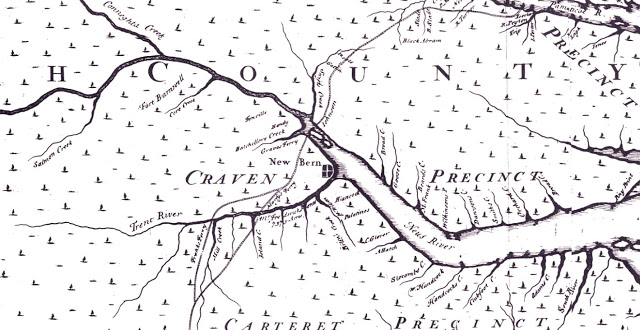
Our Palatines to America treasurer, Margie Weiler, suggested that I include information in this blog about the 1710 settlement of New Bern, North Carolina.  I  have previously written about  the 1766 North Carolina settlement of Germans in Salem.  However the New Bern settlement deserves its own mention.

Christoph von Graffenried, a native of Bern, Switzerland, born in 1661 and Franz Ludwig Michel, both part of the Ritter Company, wanted to establish a Swiss colony in the New World.  Queen Anne of England, facing a flood of Palatine immigrants made an offer of land and support for the settlement plans if they would agree to include Palatines among those they transported to the New World. 


In September of 1709, Parliament granted Graffenried and Michel more than 13,000 acres of land in the Carolinas, with a promise of assistance once they arrived.  As a result, 650 Palatines, led by John Lawson and Michael Gale, sailed from England in January 1710.  During the thirteen week voyage, they lost about one half of the Palatines as a result of the harsh conditions of the trip. When they arrived in North Carolina at the juncture of the Neuse and Trent rivers, they found that no provisions were waiting for them and no work had been done to provide shelter for them in the settlement at New Bern.


Conditions did not improve until Graffenried arrived in September 1710 with about 100 Swiss settlers.  He had the land surveyed, forests cleared and houses erected. Within eighteen months, the community seemed to be well established.  Unfortunately this good fortune did not continue for long.

The Tuscarora Indians who had inhabited the area until the arrival of European settlers, began a campaign to rid their native lands of those intruders.  In Early September 1711, Graffenried and surveyor John Lawson, who had led the initial group of Palatine settlers to New Bern, set off to explore the area north of New Bern.  The Tuscarora captured both, killing Lawson.  They let Graffenried go free because they believed that he was the governor.

While Graffenried was journeying back to New Bern, the Tuscarora attacked the white communities along the Neuse and Pamlico Rivers, killing many of the settlers.  They destroyed houses and crops and took away livestock. 

Graffenried never recovered financially from the war with the Tuscarora, and many of the original Palatines dispersed among the surviving English communities of North Carolina.  Graffenried returned to Europe.